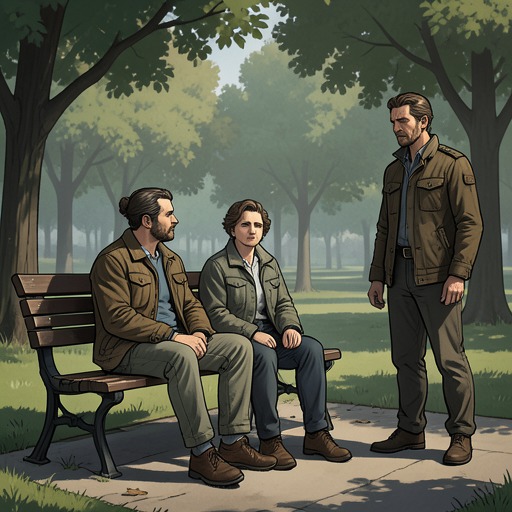
High school
Even If This Love Disappears From the World TonightHigh school is where Tooru Kamiya’s coerced confession to Maori Hino unexpectedly becomes the start of their relationship, and where their daily effort to live with her anterograde amnesia takes shape. Its classrooms and hallways first bring them together under pressure; years later, the graduation they reach there measures how much Maori has managed to build despite waking each morning without the memories of the day before.
Setting and Introduction
Shortly after a new school year begins, two boys in Tooru’s class bully the boy seated in front of him. Tooru understands that the bullies may be frustrated after working hard to enter a public college-preparatory school only to land in the non-advanced class in their second year, but their disappointment does not excuse what they do. Although he usually reads during class and does not go out of his way to become involved with others, he cannot bear to watch the victim suffer directly in front of him.
Tooru intervenes, and the ringleader offers to stop if he performs one task: tell Maori Hino, a student in Class 1, that he likes her. The assignment is meant as another act of bullying, with Tooru’s humiliation as its instrument. After school, he follows the instruction, asks Maori to go behind the school, and confesses while the ringleader watches secretly. He expects to explain the circumstances and apologize afterward. Instead, Maori says they can date under three conditions. The school is thus not merely a backdrop for a first meeting: the relationship begins in a situation neither Tooru nor the watching bullies expect to turn into a genuine bond.
Hallways, Classrooms, and a New Relationship
The next day’s school hours pass peacefully, and the bullies leave Tooru and his classmate alone. Yet the meeting with Maori remains unresolved: they have not chosen where to meet. Because Tooru had mentioned his class the previous day, he waits in his classroom after homeroom. Before staying, he says goodbye to Shimokawa, who is leaving with his mother to handle paperwork related to the family’s move and drive home. Tooru has worried that the bullies might take Shimokawa’s money if he walked alone, so the ordinary school-day departure carries the aftereffect of the threat that prompted the confession.
Tooru sits by the window as the classroom empties. He takes out a magazine and waits amid the distant sounds of the school band tuning and sports teams warming up. The surrounding activity gives the room a feeling of being halfway between isolation and belonging; through the square window, the blue sky makes the empty classroom seem like something from a sad song. After the other classes fall quiet and the hallway empties, footsteps approach: neither hurried nor relaxed, but marked by nervous purpose. Maori appears at the door, briefly raises her eyebrows in surprise, then smiles and recognizes him as her boyfriend. Her arrival turns the classroom from a place of waiting into the first site of their developing connection.
Their relationship becomes part of the rhythm of school life. More than a week into dating, Tooru realizes that little seems to have changed except how he spends his time after school—then recognizes that Maori has begun occupying his thoughts. He recalls her smiling with her chin in her hand and wonders whether he is simply captivated by her appearance or misunderstanding his own feelings because he has had so little interaction with girls. The apparently small shift in his routine marks a larger one: a relationship that began as a bully’s order is becoming emotionally real to him.
The School Years and Maori’s Condition
The school is also the setting from which Izumi Wataya looks back on the beginning of the relationship. At the start of the fall semester, three months after Maori and Tooru began dating, Izumi remembers the end of May: a boy Maori did not know stopped her in the hallway, and later Maori told Izumi about her decision when they met in front of the library. Izumi is shocked because she knows the difficulty that decision entails. Maori cannot retain new memories for more than a day; after meeting a stranger, she will wake the next morning and experience that person as a stranger again.
That condition does not have an easy remedy. Izumi explains that anterograde amnesia has no treatment and might change suddenly or remain unchanged for years. Maori, her family, and the people supporting her therefore have to persevere without knowing when or whether the condition will improve. School makes that uncertainty part of everyday life rather than an abstract medical fact: social connections must be renewed, and continuity depends on practices that can bridge the reset between one day and the next.
Tooru’s presence becomes one such support. Maori sees him almost every day over summer vacation, and Izumi observes that helping her through daily life has changed him. He also encourages her to draw again. Although Maori’s brain cannot retain new memories, her muscle memory can persist, allowing repeated practice to build skill without ordinary day-to-day recollection. The school years thus contain both an ongoing limit and a form of growth that does not depend on remembering each lesson as an event.
Graduation and the Meaning of Continuity
The final school year passes in a rush of study: summer is devoted to entrance-exam preparation, winter brings the Center Test and then the second round of exams, and spring arrives before Izumi feels the long year has fully registered. The three friends all graduate. Tooru has passed the civil-service examination in a neighboring district and will begin working at city hall; Maori has made substantial progress in drawing and plans to take art classes several times a week while waiting to see whether her amnesia will be cured. Izumi expects that she may enter her first-choice university in their prefecture.
On graduation day, Maori says she cannot believe it. What amazes her is not simply how much time has passed, but that she has remained in school long enough to graduate despite her condition. She celebrates with her diploma, a visible record of an achievement whose days she cannot carry forward in memory in the usual way. Izumi understands the accomplishment through the supports that have made continuity possible: Maori’s journal connects past versions of herself with the person who wakes each morning, drawing practice gives her a way to improve, and Tooru remains part of her life even as their daily school routine is ending.
The school’s significance therefore reaches beyond the place where the romance begins. It holds the span from an imposed confession to a relationship sustained through repeated days, and from the isolation of a classroom after homeroom to a graduation the three friends share. Maori’s diploma cannot restore the memories that reset each morning, but it testifies to what she has been able to do without them: remain, learn, practice, and reach the end of high school with a record and a community connecting one day to the next.